


How We Built Our Home While Working Full Time
- Dani
- 2 days ago
- 6 min read

When we tell people we built our home while working full time, the first question is usually the same:
“Wait… how did you actually manage that?”
Because when you picture building a house, you probably imagine someone on-site constantly, meeting contractors, answering questions, and watching every step of the process.
The biggest thing that made our situation work was a combination of clear communication, proximity to the property, and learning when we actually needed to be involved — and when we didn’t.
Here’s how the process really worked for us. And by us, I mean my husband, because to be honest I just got to pick out all the pretty stuff haha HE did ALL the work, and excelled at it with ZERO prior experience! I've said it before, but I'll say it again, YOU can do it too. Just takes perseverance, attention to detail, and willingness to figure things out.
Our Background

A little background on us, I'm an apparel designer by trade and my husband is a shop foreman / mechanic for a dump truck company.
I work in-office 5 days a week (and commute 75 miles one way), and he works at a shop 5 days a week as well, so neither one of us had work from home jobs during our build.
This is important to mention because although neither of us worked remotely, my husband was in close proximity to the property and had the flexibility to stop by when needed.
He could swing by during lunch or after work on his way home if something required it.
In my opinion, proximity is key if you’re planning to build while working full time. Being able to get there quickly if needed removes a lot of potential stress.
At the time we were also living with my parents, which happened to be roughly a middle ground between his work and my work.
Finding the Land
Before anything else, we had to find the right piece of land. I always tell people this is thee hardest part and one that requires the most patience.
We were actually living in my parents basement for 3 months until we finally found land we could put an offer on. Honestly, this phase was the biggest time commitment, mostly because it required patience more than anything else.
Once we purchased the land, the real planning began.
Designing the House
Next came the fun (and sometimes overwhelming) part: deciding what we actually wanted our house to look like. We are located in Missouri, so if you're looking for an architect reach out to me, I'd be happy to pass along the one we used!
There are a few different ways people approach this:
Buying pre-made house plans
Hiring an architect for something fully custom
Modifying an existing plan
We found a layout we liked and made adjustments so it worked better for our lifestyle. What surprised us was how many small decisions come up during this stage:
Where the laundry room should be
Pantry size
Garage layout
Window placement
Storage
When you’re working full time, most of these decisions happen at night or on weekends, often sitting on the couch with a laptop open comparing layouts. I highly recommend checking out my How to Design Your Own Floor Plan if you are near this stage or even thinking about it, that way you don't get caught off-guard or scramble.
Working With Contractors
One of the biggest questions people ask is how we handled contractor coordination while also working full time. The biggest factor that helped us was that my husband worked about 15–20 minutes away from our property.
This meant that if something came up and someone needed to meet on-site, he could get
there relatively quickly if necessary. But we made it a goal to not have to be there every time someone showed up.
Instead, he focused on very clear communication with contractors ahead of time, which made a huge difference.
Another HUGE underrated aspect is the clarity of the house plans. Our architect knocked it out of the park here, and made the communication process 100x easier just by simply making the plans easy to read for every part of the house. This is CRUCIAL. I can't express choosing your architect wisely enough. It needs to be a word of mouth recommendation, and not the cheapest bid you find to do it. Trust!!
One Lesson We Learned the Hard Way: Get Everything in Writing
If there’s one thing we learned during this process, it’s this: Always get decisions in writing.
Even when you think something has been communicated clearly. Even when you’ve talked about it multiple times. Even when everyone is on the same page in the moment.
Because once a project has dozens of moving parts and multiple contractors involved, small details can easily get lost somewhere along the way.
We learned this the hard way with our countertops.
Our understanding was that the bathrooms would have white countertops, but the kitchen would not. We had picked out a different material and everything, and felt confident that everyone understood the plan.
But somewhere between those conversations and the final order, the message got crossed.
When the countertops were delivered, the kitchen ended up with the same white material that was meant only for the bathrooms.
The worst part was that our cabinet guy ended up having to eat the cost of correcting it, which honestly made us feel terrible because it wasn’t a malicious mistake — it was just miscommunication somewhere in the process.
That situation taught us a valuable lesson: Verbal conversations aren’t enough when you’re building a home.
From that point forward, we tried to make sure that big decisions were confirmed in writing — whether that meant:
Email confirmations
Text message summaries
Written selections for materials
When you’re juggling a build while working full time, having things written down also makes it a lot easier to go back and double-check details.
Construction Phase
Once construction actually started, the progress felt much more real.





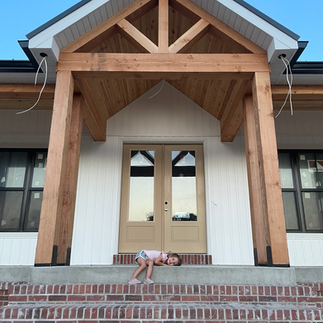
You start seeing things happen quickly:
Excavation
Foundation work
Framing
Roofing
Windows going in
Seeing the structure come together is easily one of the most exciting parts of the entire process. But it’s also when decisions start coming faster.
You’ll suddenly be choosing things like:
Flooring
Tile
Cabinets
Countertops
Lighting
Paint colors
For us, this meant a lot of evenings reviewing samples and a lot of weekend stops at suppliers. If I could go back, I'd use my Room x Room Finish Checklist to make all the decisions, source materials, and fill in everything ahead of time, rather than on the fly. This would have made the process so much smoother!!
Managing the Process While Working Full Time
This is the part people are usually the most curious about.
The truth is, there wasn’t some perfect system — but a few things helped a lot.
Clear communication with contractors
Instead of needing to physically be on-site constantly, we tried to make sure expectations and plans were very clearly communicated ahead of time. This saved a lot of unnecessary trips.
Being close to the property
Having the property within about 15–20 minutes of where my husband worked made it much easier to stop by if something unexpected came up. That proximity took away a lot of potential stress.

Accepting that evenings and weekends would be busy
For several months, many of our evenings looked like:
Reviewing quotes
Making design decisions
Responding to contractor messages
Talking through the next phase of the build
Cleaning up after the previous contractor to prepare for the next
It wasn’t forever, but during the build, it definitely became part of our routine, and we didn't do a whole lot else for that 13 month period to be completely honest. Especially as parents AND with one on the way at the time, we were in home-build mode 24/7.
What We’d Do Differently
Looking back, there are a few things we would probably change if we ever built again.
We would:
Finalize more design decisions earlier
Ask more timeline questions upfront
Do one of those walkable plans! Although we LOVE our layout, this would have been really cool to experience and perfect on the front end.
Almost everyone we talked to who had built a house told us the same thing:
There will always be unexpected things during a build.
And they were right.
Was It Worth It?
Absolutely.
Even though balancing a home build with full-time jobs, parenting, living WITH my parents, AND expecting (LOL) wasn’t always easy, there’s something really special about living in a home you watched come together piece by piece.
Every room, every decision, every detail has a story behind it.


Comments